Laser Tag Field and Arena Design
Build your own laser tag field or arena.
Making a Laser Tag Field
With Steradian Laser Tag equipment, you can play just about anytime or anywhere. It’s generally easy to set up and play, no matter what kind of play area you have. However, it’s important to keep a few things in mind to make sure your play area is fun and safe.
- Having barriers or objects for players to hide behind is always good for your play area. If you are outdoors, trees and bushes make great natural barriers.
- Understanding the boundaries of your play area is important. Players should know where they can and cannot be. This also helps to keep players safe in a larger play area.
- Have an area for players to start at. Have an area for players to go when they are eliminated. Have an area for the equipment and set up.
- If you’re playing in a dark area, it’s important to make sure that there is enough light for players to navigate around. This keeps players safe and prevents them from becoming disoriented.
- To keep yourself and others safe, remember to put orange tape on the end of your guns. This will ensure that others know the guns you have are toy guns. Check your local laws if you have specific questions regarding the orange tape.
If you’re using public land, there are a few more things to know.
- Make sure to carry insurance in case a player trips and falls. Many public areas require proof of insurance before you can use their land.
- Let local authorities know before hand that you’ll be playing Laser Tag in that area. This helps prevent any potential problems or confusion.
Backyard, Small Field or Indoors
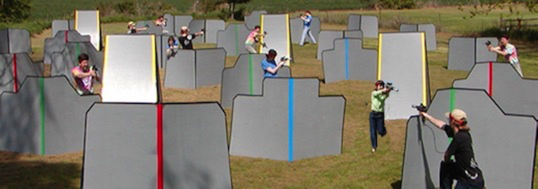
These small play areas are great for kids and teenagers. Generally, you’ll have a flat space filled with different types of barriers and objects. The barriers or structures that you use should be large enough to fully hide behind. Steradian Reflex Barriers are a great option for this type of field. Set up as many barriers as you need for your area. A good rule is to have about twice as many barriers as players. It also works well to have teams start on opposite sides of this type of play area. The area for your equipment can be wherever is most convenient.
When playing with a smaller area, try to have a space that is as big as a full length basketball court. Having a play area smaller than that will limit the amount of players and can cause more accidents to happen. (Players will run into each other more often). Kids won’t have as much fun because there is less space to run around in. You’ll also have trouble fitting in the barriers you need.
With a small field, teams are usually around 5 - 8 people per team. Depending on the game mode and size of your field, you can easily change the amount of players that you have. Game modes such as Team Elimination, Immortal Arena, Powerup Quest, and Free For All are good choices on smaller fields.
Because of the small size and quick nature of the games, a shorter time limit of 4 - 6 minutes works well. Having a referee to help players and to keep games running smoothly is also recommended. Here are some pictures that give an example of a setup we used for a local event.
Forest Fields
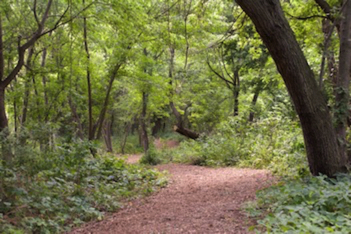
This picture above is an example of a field we use to play. The example field shown here is about 5 acres.
This type of field will work well with players of any age. We often have kids, teenagers, young adults and older folks all playing at the same time. Because of the space, you can set up the field to be used with any of the Steradian game modes. Experiment with what games work best for your field.
One major advantage of a forested field is that you don’t need to build any barriers, since the natural foliage works as cover for players. However, feel free to add any type of structures or barriers to your field because they can add variety to your field.
With a forest field, having trails and areas with no foliage is important. This will let players have more freedom to move around and plan out how they will play. It is also important because you need an area for your equipment and for players to return to when they are eliminated. If you do have trails, marking them with tape or paint is a great way to help players understand where they are. Having maps available and posted around the field is another good idea. You’ll have to maintain this type of field to ensure it’s ready to be used, but you can shape and develop it however you like.
Forest Fields can vary greatly in size. Because of this, it’s very important to explain the boundaries of the field. Otherwise, players can get lost or disoriented. With bigger fields, you can make teams much larger as well. Depending on the size, anywhere from 5 to 50 players on each team can work. If you have a small group on a large field, you can tape off a smaller section and have them play there. There is plenty of opportunity for players to practice strategy and tactics, because there will often be small groups of players running around together on the field.
Time limits will usually be increased anywhere from 20-60 minutes, allowing players to move around the field, strategize and finish the game mode objective. To help players stay safe, we recommend having a few referees in your field.